
Opening perspective
Incorporated Cell Company structures are becoming a practical answer to one of the biggest problems facing emerging managers: how to launch with institutional discipline without rebuilding the same operational stack every time a new strategy is created. This matters because the fund management industry is becoming more selective, more operationally mature, and more focused on evidence of institutional discipline. Managers can no longer rely on performance narrative alone. They need a structure that gives allocators confidence before, during, and after the allocation process.
Market context
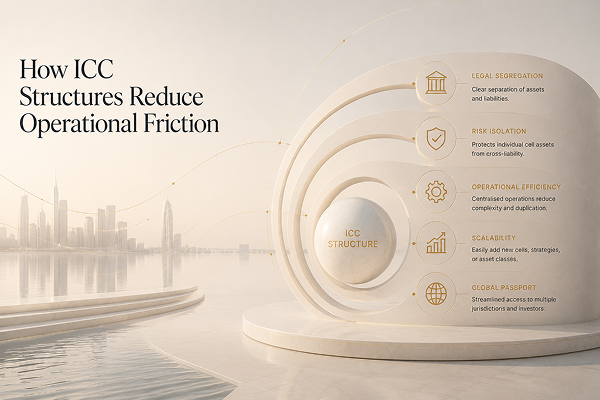
For managers entering ADGM, the appeal of an ICC is not only legal segregation. The deeper value is operational efficiency. A single parent framework can support multiple incorporated cells, each with its own strategy, investor base, and economic profile, while common governance, fund administration coordination, onboarding workflows, and service-provider oversight sit around the structure. The wider market is moving toward clearer governance, stronger service-provider ecosystems, improved investor onboarding, and more transparent reporting. For emerging managers, this creates both pressure and opportunity. The pressure is that investors expect more. The opportunity is that managers who adopt the right infrastructure early can appear more credible, more prepared, and more scalable than peers trying to assemble everything manually.
The real problem
The structural problem is duplication. A manager launching standalone vehicles often repeats legal formation, administrator onboarding, auditor engagement, governance design, account opening, compliance workflows, and investor documentation for every fund. This creates cost pressure before the strategy has even proved its commercial demand. It can also create inconsistent operating standards across strategies, which weakens allocator confidence. This is where many otherwise capable managers lose momentum. They may have a strong strategy and credible experience, but they do not yet have a complete institutional operating model. That gap becomes visible during due diligence. Investors ask practical questions about who performs what function, how information flows, how conflicts are controlled, how investors are serviced, and how oversight is maintained. Weak answers do not always kill a raise immediately, but they reduce confidence and slow decision-making.
The institutional insight
The real insight is that sophisticated allocators are not only asking whether a fund is legally segregated. They are asking whether the platform is operationally coherent. An ICC framework can create a cleaner operating environment because each cell is distinct, but the institutional architecture around the cells can remain consistent. That consistency matters when managers want to add strategies, onboard new allocators, or demonstrate control to service providers and regulators. This is why infrastructure should be viewed as part of the product itself. A fund is not just a portfolio. It is a legal, operational, regulatory, and investor-service framework built around a portfolio. When that framework is strong, the manager can spend more time discussing strategy and less time defending process. When that framework is weak, the investment idea becomes harder for allocators to approve.
What sophisticated allocators notice
Sophisticated allocators often look for signals before they read every document in detail. They look at the jurisdiction, the manager’s operating discipline, the quality of the fund structure, the administrator relationship, the custody and banking arrangements, the reporting cadence, and the governance framework. They want to know whether the manager has thought through the full lifecycle of the fund, not just the launch announcement. This includes subscriptions, redemptions, valuation, capital calls if relevant, investor updates, audit timing, risk escalation, and continuity planning.
How Nour Partners helps
Nour Partners helps by providing managers with access to an ADGM-focused institutional platform built around fund hosting, incorporated cell structures, operational coordination, and allocator-ready governance. Instead of asking a manager to build the full institutional layer independently, Nour Partners gives them a route into a structure where the parent platform, licensed investment-management overlay, administrator coordination, onboarding processes, governance model, and service-provider ecosystem can work together. The important point is that Nour Partners should not be positioned as a marketing shortcut. It should be positioned as institutional infrastructure. The platform helps managers reduce complexity, improve credibility, and move into market with a structure that is easier for allocators to understand. It gives managers a more professional environment from which to build investor relationships, rather than forcing them to create every component in isolation.
Nour Partners application layer
For Nour Partners, the correct positioning is not that the platform replaces the manager. The manager still owns the investment thesis, the investor relationships, and the portfolio decisions. Nour Partners strengthens the institutional environment around that manager. It helps create a cleaner route through structure, launch preparation, operational coordination, governance presentation, and allocator-facing readiness. This is why the insight should not read like a generic market article. It should show the reader that the problem is real, that sophisticated investors notice it, and that Nour Partners exists to make the manager more institutionally credible without taking away their strategic identity.
Practical application
In practical terms, this means a manager can approach the market with a clearer operating story. The fund structure is easier to explain. The role of the licensed manager is clearer. The role of the administrator is clearer. Investor onboarding can be described with more confidence. Governance is not an afterthought. Reporting and operational workflows can be presented as part of a coherent platform. This does not remove the need for the manager to demonstrate investment skill, but it improves the environment in which that skill is assessed.
Strategic implication
The strategic implication is significant. Managers who launch with institutional infrastructure are better positioned to scale across strategies, geographies, and investor groups. They can build credibility earlier, reduce repeated setup work, and avoid appearing underdeveloped when speaking to allocators. For family offices and institutional investors, this creates a more comfortable diligence pathway. For the manager, it creates a more stable foundation for growth.
Closing view
For emerging managers, the decision is no longer simply whether to launch a fund. The better question is whether the launch structure can support the second, third, and fourth strategy without creating operational drag. ICC structures are valuable because they allow managers to scale inside a more disciplined institutional environment. Nour Partners sits in that gap between manager ambition and institutional readiness. The future of fund formation will increasingly favour managers who combine specialist investment capability with professional infrastructure. A strong idea may open the conversation, but structure, governance, and operational confidence help convert that conversation into capital. Nour Partners is designed to sit at that intersection.